Technology

Synergy Technology

The Foundation for the Next Generation of AI Applied Applications

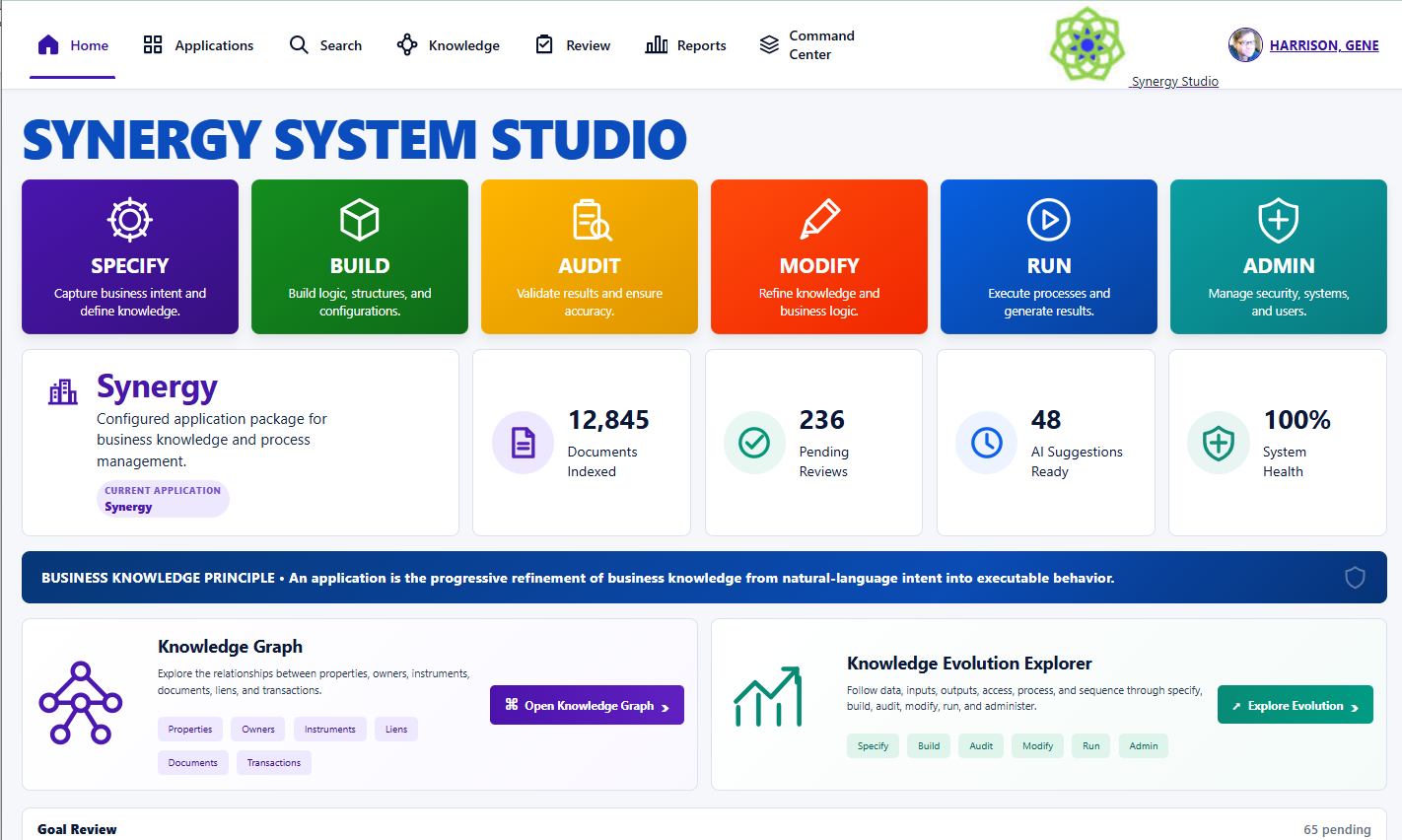
The Synergy System is an innovative AI Applied Application technology that represents an intelligent paradigm shift in AI technology. Synergy System is not just a tool, it represents a new AI Solution—one in which human intent, symbolic understanding, and neural execution converge and synthesize into trustworthy AI programs. The Synergy Solution is used to specify, develop, and run multi-functional, trustworthy applications faster and with higher quality. Synergy’s Solution is like having a highly skilled software development team at your command, but without the complexity and cost typically associated with using inadequate, unreliable AI tools.

Synergy System uses the Neurosymbolic AI (NeSy) approach which combines the pattern recognition of neural networks with the logic-based reasoning of symbolic AI to improve AI reliability, explainability, and efficiency. As a differentiator, Synergy is the first to achieve an AI program storing symbolic rules and knowledge as vectors and integrates machine learning rather than generating programming code such as Python. This advancement is a more modern, high-value strategy within this field, often referred to as neuro-vector-symbolic architecture (NeuroVSA) or knowledge-infused learning allowing the AI to learn an estimated 100 times faster.

Synergy System’s advanced neuro-vector-symbolic architecture (NeuroVSA) also includes a unique program structure in its "world model". Synergy’s world model is a representation of the patterns, rules, and causal relationships that govern an AI applied application and has its own "physics" (logic, syntax, and execution flow), which all other world models are missing. The Synergy world model and its AI program structure help guide the NeuroVSA on how to build complete no code generated AI applied applications versus just coded pieces of AI programs and represents years of research by mathematicians and AI and software engineering domain experts.

Synergy employs AI to create smarter programs and support non-technical users. By grounding the AI in our robust methodology, we ensure that the resulting computer program is not a black-box mystery.


Synergy sets the groundwork for composable AI systems—where natural language builds, updates, and orchestrates multiple models across domains.

Why it matters: It aligns with the emerging trend toward AI agents, multimodal pipelines, and human-AI collaboration. This is done with prompting and workflows that walk the user through a program structure even if they are not familiar with the concept. We've also added innovation to the way a user interacts with the program, and its various visual displays.

  • LLM-based Natural Language Interface (NLI)
  • Accepts only natural language as input
  • Generates visible programming structure (e.g., a flowchart, logic graph, or editable pseudo-code)
  • Automatically builds and trains a neural network behind the scenes
  • Requires no coding knowledge and eliminates the need for traditional programming languages and compiling.
  • Allows human users to review, edit, and update the system in natural language.

  • Meeting the Surging AI Application Demands

    As the demand for applications is projected to outpace IT personnel capacity by 500%, the Synergy System emerges as a game-changing solution:

    1. Massively Expanded User Base

  • Advantage: Opens AI development to non-coders—business analysts, domain experts, educators, creatives.
  • Why it matters: AI coding platforms (like GitHub Copilot or Code Interpreter) still require technical understanding. This new model breaks that barrier.

  • 2. Faster Prototyping and Iteration

  • Advantage: Instant design → test → iterate cycles with no manual coding.
  • Why it matters: LLM-generated code still requires debugging and deployment; a natural-language-first system could abstract that away and reduce cycle time dramatically.

  • 3. Transparency & Explainability

  • Advantage: Users can see and understand the logic via visual programming structures.
  • Why it matters: Current AI coding often produces black-box solutions. Visual structures are crucial for compliance, audits, and trust—especially in finance, healthcare, and education.

  • 4. Editable by Anyone, Anywhere

  • Advantage: Allows live updates and improvements by people closest to the problem.
  • Why it matters: AI developers often misunderstand domain-specific requirements. Empowering end-users to tune models themselves leads to better outcomes.

  • 5. Lower Cost of Development and Ownership

  • Advantage: Reduces reliance on expensive ML engineers.
  • Why it matters: AI coding platforms still require hiring or contracting skilled developers; this model could slash costs across industries.

  • 6. Competitive Differentiation

  • Advantage: A company that can make neural networks visibly understandable and editable gains an edge in industries demanding interpretability.
  • Why it matters: As regulations increase around explainable AI (e.g., EU AI Act), this feature may become not just an advantage—but a requirement.

  • Synergy has a unique technology solution:

    Synergy System demonstrates how a world model and hybrid AI approach has the potential to transform the way software applications are created and maintained. This paradigm shift replaces slow, difficult development with surprising speed and dependable application creation that facilities deployment of AI on a wide scale to meet muti-functional, specialized needs for any market, domain, or subject. It serves as a application program robot that learns as it goes and produces applications rapidly and reliably. There is no other AI System that does this.


          We figured out how to train our own AI which includes a neural net that simulates a human brain and learns as it goes. To get started, you create a document that describes the high-level requirements using our user-friendly method, and follow the menu choices to get your application.

    The requirements include key data inputs to organize the application, English names of the processes to perform that get translated into algorithms behind the scenes, and the sequence or order of how you want the information to be processed and where to store it.